Two kinds of fraud hit small and mid-size businesses hard — and they share a root weakness: a legitimate-looking channel nobody double-checks.
| Side | Failure mode | Downstream damage |
|---|---|---|
| Your domain | Soft SPF / DMARC / MTA-STS lets criminals impersonate @yourfirm.com | Wire fraud, fake invoices, password-reset traps aimed at clients and vendors |
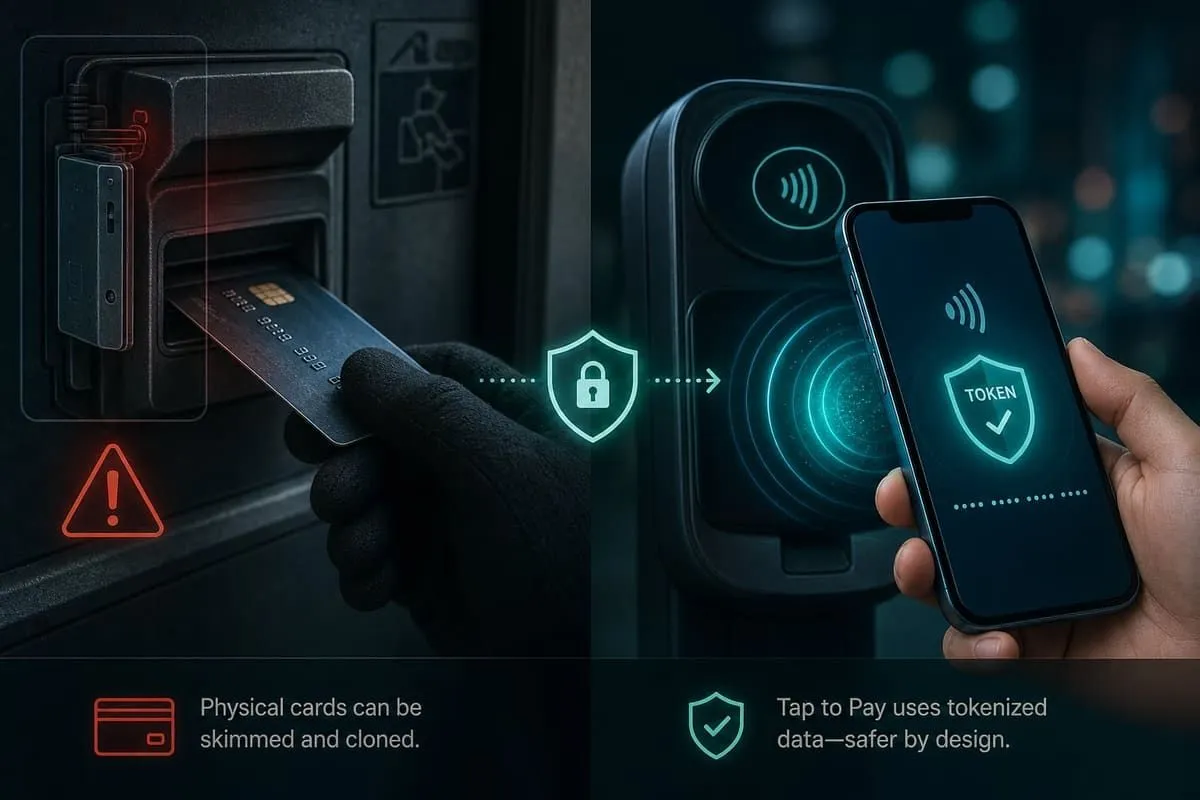
| Everyday payments | Typing or swiping the real card at every checkout / pump / convenience ATM | Skimming, Magecart form theft, and card fraud that’s hard to trace |
This guide covers both: what 100% actually means on an EmailMeNow domain audit, and the habits — tokenized checkout, Tap to Pay, virtual card numbers, skimmer checks, alerts, MFA — that keep your business and your customers’ cards safer.
Domain scores below come only from audit.emailmenow.com. CMS / stack notes come only from our website-tech probes — not Mozilla Observatory, SSL Labs letter grades, or invented “98%” tables.
What a 100% Domain Security Score Requires
At EmailMeNow, 100% is the ideal — full coverage across the layers criminals actually abuse — not a “good enough” grade with one checkbox left open. A free scan at audit.emailmenow.com evaluates:
| Layer | What’s checked | Why it matters |
|---|---|---|
| Email authentication (Identity) | SPF, DKIM, DMARC — ideally p=reject | Stops mail that only looks like it came from your domain |
| Transport security | MTA-STS (ideally enforce) and TLS-RPT style reporting | Stops silent downgrade of inbound mail to weaker encryption |
| Website security | HSTS, CSP, frame controls, related headers | Reduces clickjacking / script-injection exposure on public pages |
| Hardening signals | Infrastructure and endpoint-related posture in the report | Shrinks what attackers can casually probe |
Domains rarely fail every layer. More often one gap caps the whole score — classic pattern: SPF present, DMARC still monitoring (or soft), no MTA-STS. That profile shows up across industries; for one published sample see Top Nevada law firms email security audit (2026).
Business takeaway: a domain stuck in the midrange is the one criminals spoof for BEC / invoice fraud. Harden your mail before you coach customers on card hygiene — run audit.emailmenow.com on your primary domain, then contact us if you need help closing gaps (College Station, Texas; law firms, healthcare, CPAs, dealers, title, advisors, schools, and local government).
Quick Decision Guide (cards)
| Situation | Safer default | Why |
|---|---|---|
| Online checkout | Wallet / Stripe Link / PayPal / Click to Pay or a virtual card number | Merchant never stores (or rarely sees) your real PAN |
| In-store reader | Tap to Pay (phone, watch, or contactless card) | Terminal gets a token / dynamic cryptogram, not your durable card number |
| Gas pump / unattended kiosk | Pay inside, or tap with a wallet; use credit not debit | Outdoor pumps and freestanding ATMs are skimmer favorites (FBI) |
| Cash from ATM | Bank-branch or cardless ATM via your bank app | Convenience-store ATMs are frequent overlay targets |
| Recurring SaaS / store account | Link a virtual or tokenized method once | Limits blast radius if that one merchant is breached |
Stop Entering the Real Card on Every Site
Every time you type PAN + expiry + CVV into a standard HTML form, you expose that data to several vectors:
| Vector | What happens |
|---|---|
| Keyloggers | Malware on your device records keystrokes before encryption helps |
| Magecart / digital skimming | Malicious JavaScript on a merchant checkout page intercepts the form as you type |
| Merchant database breaches | Stored PANs leak months later in breach dumps |
| Support / phishing pages | Fake “update your billing” forms that look like the real brand |
Prefer tokenization and digital wallets
Instead of sharing your Primary Account Number (PAN) with every shop:
| Option | What you gain |
|---|---|
| Google Wallet / Apple Pay / Samsung Pay | Device unlock + network token / Device Account Number; often useless if stolen out of context |
| Stripe Link | Returning checkout on participating sites without retyping the full PAN |
| PayPal | Layer between merchant and funding source when Link / Wallet isn’t offered |
| Click to Pay (card-network option) | Network-level recognition so you aren’t pasting the embossed number on every site that supports it |
Tokenization means the merchant and many middle hops see a stand-in. Your embossed plastic number stays with the wallet issuer or bank.
| Habit | Do this |
|---|---|
| First visit to a store | Prefer Wallet / PayPal / Link / Click to Pay when offered |
| Guest checkout | Prefer one-time or merchant-locked virtual numbers from your issuer |
| “Save card for later” | Only on merchants you trust — still prefer a wallet token or virtual PAN |
| Business travel sites | Use a virtual number with a spend or expiration limit |
Eradicate Unnecessary Physical Card Contact
Tap to Pay, watches, and linked store cards
| Method | Why it beats a swipe / insert |
|---|---|
| Phone or watch Tap to Pay | PAN is not exposed the same way a magstripe swipe is |
| Contactless chip card tap | Better than swipe; phone wallets stay stronger if the plastic is later cloned |
| Store / membership linked to a CC | Example pattern: warehouse-club cards (e.g. Costco Anywhere Visa by Citi) linked in the merchant app so membership + pay can run from the account/app barcode without handing over plastic every visit |
Physical plastic is a backup — not the daily driver for pumps, corner stores, and random e-commerce.
Skimmers, Shimmers, and Freestanding ATMs
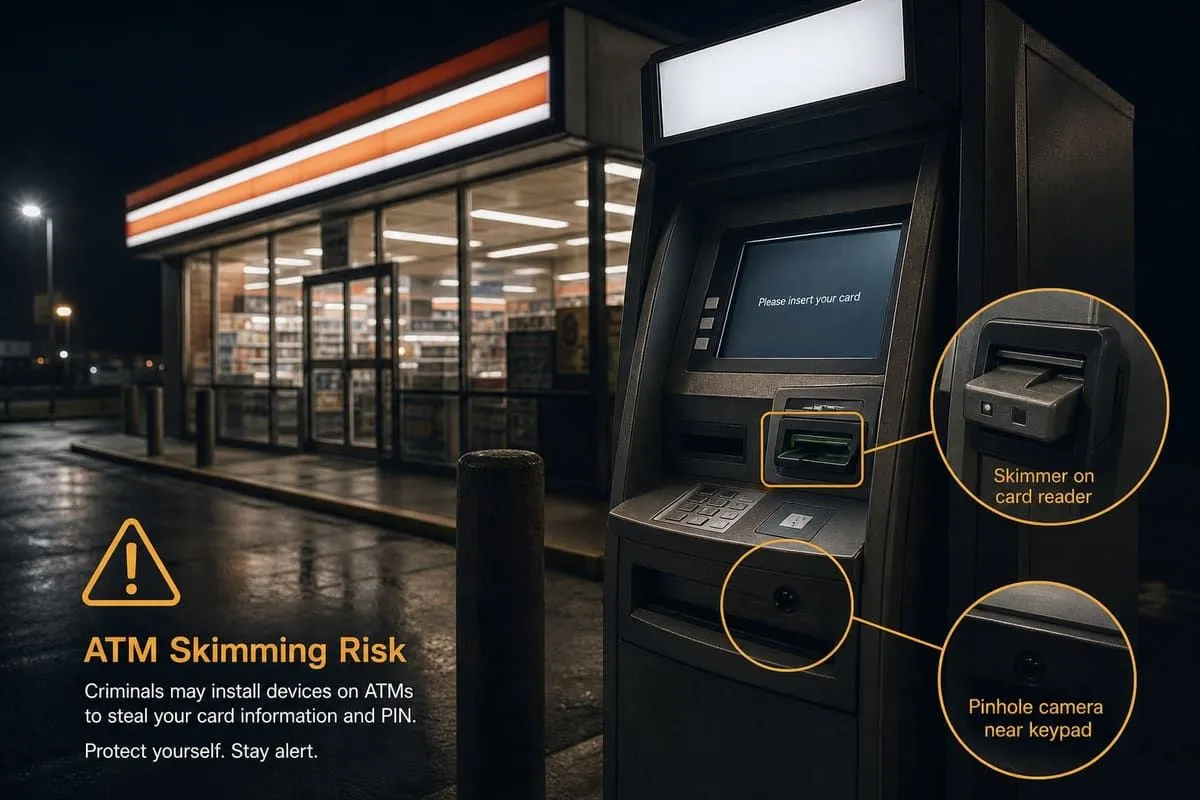
The FBI describes illegal devices on ATMs, POS terminals, and fuel pumps — including overlays and gear on exposed cables at freestanding convenience-store ATMs. The U.S. Secret Service leads many access-device fraud cases at pharmacies, grocery stores, and gas stations.
2025 scale (official): In a January 2026 release, the Secret Service reported 22 EBT/ATM skimming outreach operations, 411 illegal devices removed, nearly 60,000 terminals inspected, and an estimated $428.1 million in potential loss prevented. Early 2026 city operations continued that pattern (dozens more devices pulled in cities such as Cleveland and Denver).
Local example (July 2026): The Caroline County (VA) Sheriff’s Office warned after a skimmer was found on a gas-station ATM near I-95 (Pit Stop Exxon, Ladysmith). Officials described a near-exact replica overlay of the ATM’s top portion; reporting noted these overlays are often Bluetooth-equipped so thieves can download stolen card data without removing the device. Travelers using interstate convenience ATMs should treat that as a standing risk pattern — not a one-off Virginia quirk.
Industry analysts still flag non-bank / standalone ATMs as a disproportionate compromise location versus branch machines (ABA summary of FICO Card Alert trends — bank ATMs were still roughly a quarter of compromise locations in that reporting, not “safe by default”).
| Device type | Rough idea |
|---|---|
| Skimmer | Overlay or internal capture aimed at magstripe / reader data (some store data for Bluetooth pickup) |
| Shimmer | Thin insert inside a chip slot meant to intercept EMV traffic |
| Hidden camera / keypad overlay | Captures PIN while the reader steals card data |
| POS overlay | Seconds-long install; FBI notes distraction of clerks (e.g. asking for an item behind the counter) while a device is placed |
Five-second reader check (wiggle test)
| Check | What to look for |
|---|---|
| Wiggle / tug | Gently pull the card bezel — legitimate slots feel solid; overlays often shift |
| Fit / color | Bulky, crooked, mismatched graphics vs. neighboring pumps |
| Residue | Glue, tape, scratches, broken security seals |
| Keypad | Spongy overlay; cover the PIN with your hand anyway |
| Location | Prefer pumps near the attendant; indoor, well-lit, bank-attached ATMs |
| Outcome | If the ATM keeps your card, call the issuer immediately |
Capital One’s consumer guidance stresses contactless payments, digital wallets, and cardless ATM withdrawals where supported.
How to avoid dipping a card at a risky ATM
| Prefer | Avoid when you can |
|---|---|
| Cash from a bank-branch ATM or teller | White-label ATM inside a convenience store |
| Cardless ATM in your bank app (Chase Cardless Cash, Bank of America Cardless Cash, and similar features at other banks) | Swiping magstripe “for older machines” |
| Credit (issuer floats the risk) if you must dip | Debit + PIN at an unattended pump |
| Pay for fuel inside; or run debit as credit to skip the PIN when the terminal allows | Outer-island pumps that feel “upgraded” with odd bezels |
Virtual Credit Cards — One Number Per Merchant
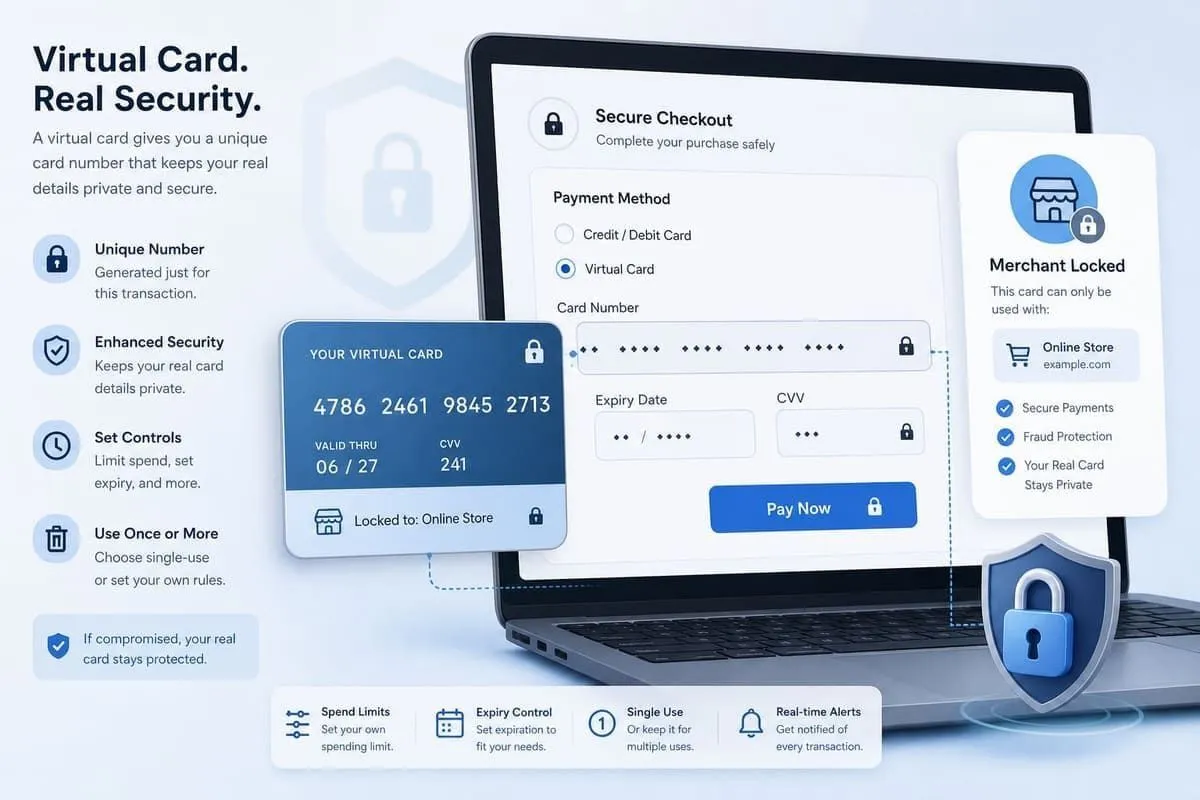
Virtual account numbers (VANs) let Capital One, Citi, and others issue a unique card number tied to your real line of credit — often merchant-locked or limited by date / amount.
[ Your real credit account ]
            │
   ┌────────┴────────┐
   ▼                 ▼
[ Merchant A VCC ] [ Merchant B VCC ]
only works at A only works at B| Issuer pattern | Practical use |
|---|---|
| Capital One virtual card numbers (Eno / app) | Store-specific or general virtual numbers; lock or delete after suspicious activity (overview) |
| Citi virtual account numbers | Generate before checkout; set expiration / limits when available |
| Privacy.com / bank equivalents | Useful when your primary issuer lacks clean virtual numbers |
Rule of thumb: one virtual number per recurring merchant (streaming, SaaS, that one sketchy shop). If the merchant is breached, you kill one token — not every autopay in your life.
Harden the Account Perimeter
| Control | Why it matters |
|---|---|
| Push alerts at $0.01 (or the lowest threshold) | Spot micro-authorization tests before a big fraud wave |
| MFA — prefer authenticator app or passkeys / hardware keys over SMS | SIM-swap still breaks SMS OTP on bank and wallet portals |
| Card Lock in the issuer app | Keep seldom-used plastics locked until the moment of purchase |
| Prefer credit over debit for day-to-day spend | Debit + PIN is skimmer gold against your checking balance |
| Password manager + unique passwords | Bank credential reuse turns one breach into account takeover |
| Credit freeze / lock when not applying | Blocks new accounts opened with stolen identity data |
| Don’t text photos of your card | Support scams still harvest PAN + CVV from “verify” requests |
| Shred retired plastics | Embossed numbers still fuel card-not-present testing |
| Review recurring charges monthly | Replace stored PANs with virtual numbers where possible |
| Business cards on a separate account | Softens blast radius for company SaaS vs. household spend |
| Phishing-resistant habit | Never follow “fraud team” links in unexpected mail/SMS — open the official app |
| Smishing after a skim | Stolen cards are often followed by texts impersonating the bank’s fraud desk to harvest CVV or OTP — a real bank won’t ask for those over text |
| Fast dispute | Most issuers zero-liability unauthorized charges reported promptly |
| Guest checkout on one-off merchants | Nothing durable sitting in that merchant’s vault for the next breach |
Payment & Authority Domains We Scored
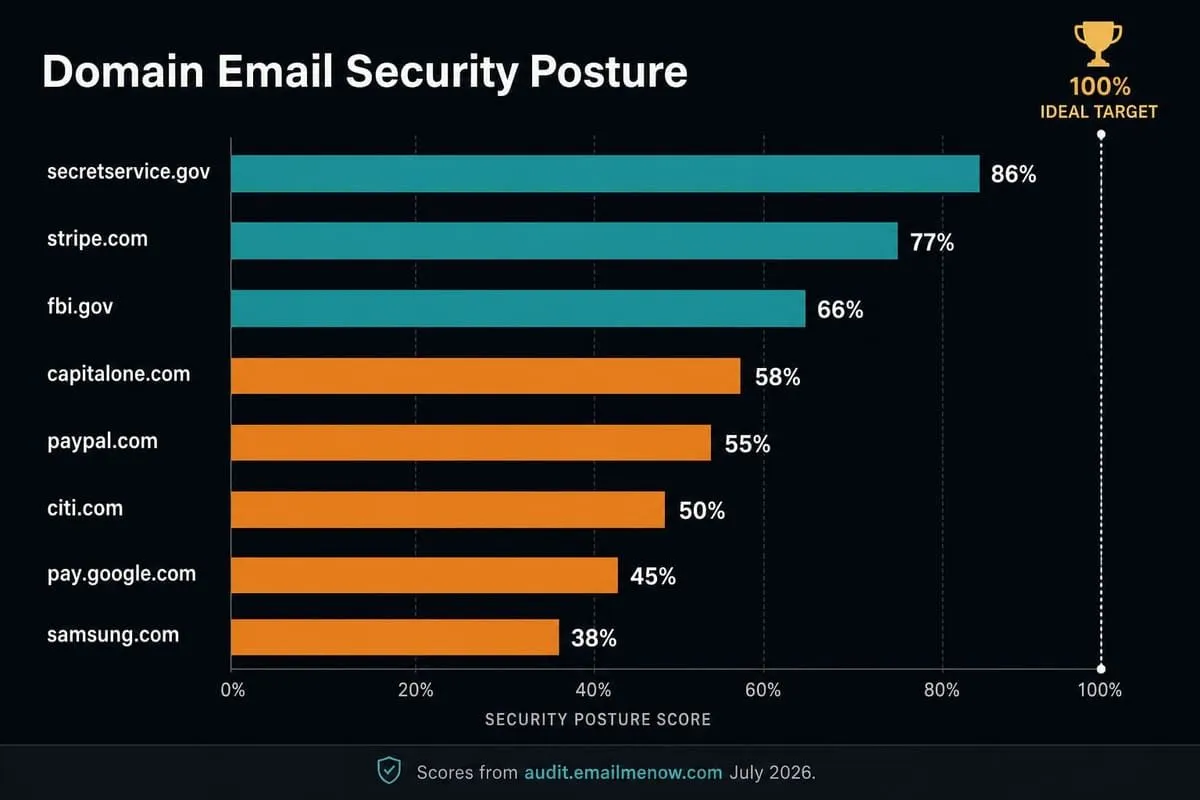
Authority for these scores: audit.emailmenow.com only (EmailMeNow identity, transport, and website scoring). 100% is the ideal. Snapshot date: July 14, 2026. Sorted highest → lowest.
| Domain | Overall | Identity | Transport | Website | Level |
|---|---|---|---|---|---|
| secretservice.gov | 86% | 90% | 45% | 92% | Strong |
| stripe.com | 77% | 65% | 15% | 100% | Good |
| fbi.gov | 66% | 75% | 45% | 45% | Above Average |
| capitalone.com | 58% | 60% | 15% | 45% | Average |
| paypal.com | 55% | 60% | 45% | 45% | Average |
| citi.com | 50% | 40% | 15% | 45% | Average |
| pay.google.com | 45% | 0% | 15% | 92% | Below Average |
| samsung.com | 38% | 10% | 15% | 45% | Weak |
| Finding | Detail |
|---|---|
| Ideal score | 0 of 8 at 100% overall |
| Soft transport | Several payment brands at 15% Transport — limited encrypted-mail transport posture on the scored hosts |
| Soft identity | Weak Identity on pay.google.com / samsung.com → spoofed “wallet security” mail risk |
| Strongest here | secretservice.gov (86%); Stripe Website category at 100% |
| Consumer takeaway | Use their payment products; still open the official app for security events — don’t trust inbound email alone |
Third-party header letter grades (Mozilla Observatory, SSL Labs A/B scales, invented 90–98% tables) are not used here and are not interchangeable with EmailMeNow overall scores.
Run or refresh any score yourself: stripe.com · paypal.com · pay.google.com · capitalone.com · citi.com · samsung.com · fbi.gov · secretservice.gov
Website stack note (website-tech authority)
Passive website-tech probes on July 14, 2026 covered all eight domains (8 probed, 1 notable):
| Domain | Notable finding |
|---|---|
| secretservice.gov | Drupal reports major 11 while latest patch line is 11.4.3 |
| Others | No notable outdated CMS / PHP / short-horizon TLS alerts in this pass |
Stack freshness is a separate signal from card tokenization quality. For readers, the win is still how you present the card, not chasing a government site’s Drupal minor version.
15-Minute Setup Checklist
| Step | Action |
|---|---|
| 1 | Scan your business domain at audit.emailmenow.com — aim for 100% (DMARC reject + MTA-STS) |
| 2 | Install Google Wallet (or Apple Pay) and add your primary credit card |
| 3 | Set issuer push alerts to the lowest amount (ideally every charge) |
| 4 | Enable app / passkey MFA on bank, card, PayPal, and email (avoid SMS-only) |
| 5 | Create a virtual number for your next new subscription |
| 6 | Find cardless ATM in your bank app; practice once at a branch machine |
| 7 | Default online checkout to Link / PayPal / Wallet / Click to Pay, not manual PAN entry |
| 8 | Lock seldom-used plastics in the issuer app |
The Common Thread
A spoofed domain and a skimmed card both exploit trust in a channel that looks normal. DMARC p=reject + MTA-STS closes the email gap for your firm. Tokens, Tap to Pay, virtual numbers, and a five-second tug on the reader close it for payments. Neither takes long — both are cheaper than the fraud they prevent.
Run a free domain scan: audit.emailmenow.com
Need help closing gaps? Contact EmailMeNow — College Station, Texas.
Related Resources
- FBI — Skimming
- U.S. Secret Service — ATM & POS skimming
- Secret Service — 2025 skimming outreach results
- WRIC — Caroline County VA ATM skimmer warning (July 2026)
- Capital One — Credit card skimmers
- Capital One — Virtual card numbers
- Forbes Advisor — credit card processing overview (merchant side)
- Top Nevada law firms email security audit
- Texas real estate wire fraud / BEC
- Gmail calendar phishing protection
Educational overview for EmailMeNow readers (College Station, Texas and remote). Not legal, tax, or bank advice. Card terms and virtual-number features vary by issuer and product; confirm in your bank’s app. Domain scores: audit.emailmenow.com only. Stack notes: website-tech probes only. Snapshot July 14, 2026.