The FBI issued an urgent public service announcement about Kali365, a phishing-as-a-service (PhaaS) platform that lets attackers steal Microsoft 365 OAuth tokens and gain persistent access without passwords or additional MFA challenges — even when victims have multi-factor authentication enabled.
Read the FBI IC3 PSA:
https://www.ic3.gov/PSA/2026/PSA260521
What Is Kali365
First observed in April 2026, Kali365 is distributed primarily via Telegram. Subscribers get AI-generated lures, automated campaign templates, victim-tracking dashboards, and device-code OAuth capture — lowering the skill bar for compromising Microsoft 365 tenants.
The FBI warns the kit enables access to Outlook, Teams, OneDrive, and other SSO-connected SaaS apps, fueling data theft, BEC wire fraud, and ransomware follow-on activity.
How the Attack Works
- Lure — Victim receives email impersonating a trusted cloud or document-sharing service with a device code and instructions to visit Microsoft’s real verification page.
- Authorization — Victim pastes the code on login.microsoftonline.com, unknowingly authorizing the attacker’s application.
- Token theft — Attacker captures OAuth access and refresh tokens.
- Persistence — Attacker uses the tokens repeatedly without re-entering MFA.
This is device-code phishing — it abuses Microsoft’s legitimate OAuth 2.0 device authorization flow rather than stealing passwords.
Illustrated attack chain
Step 1: Phishing lure with a device code
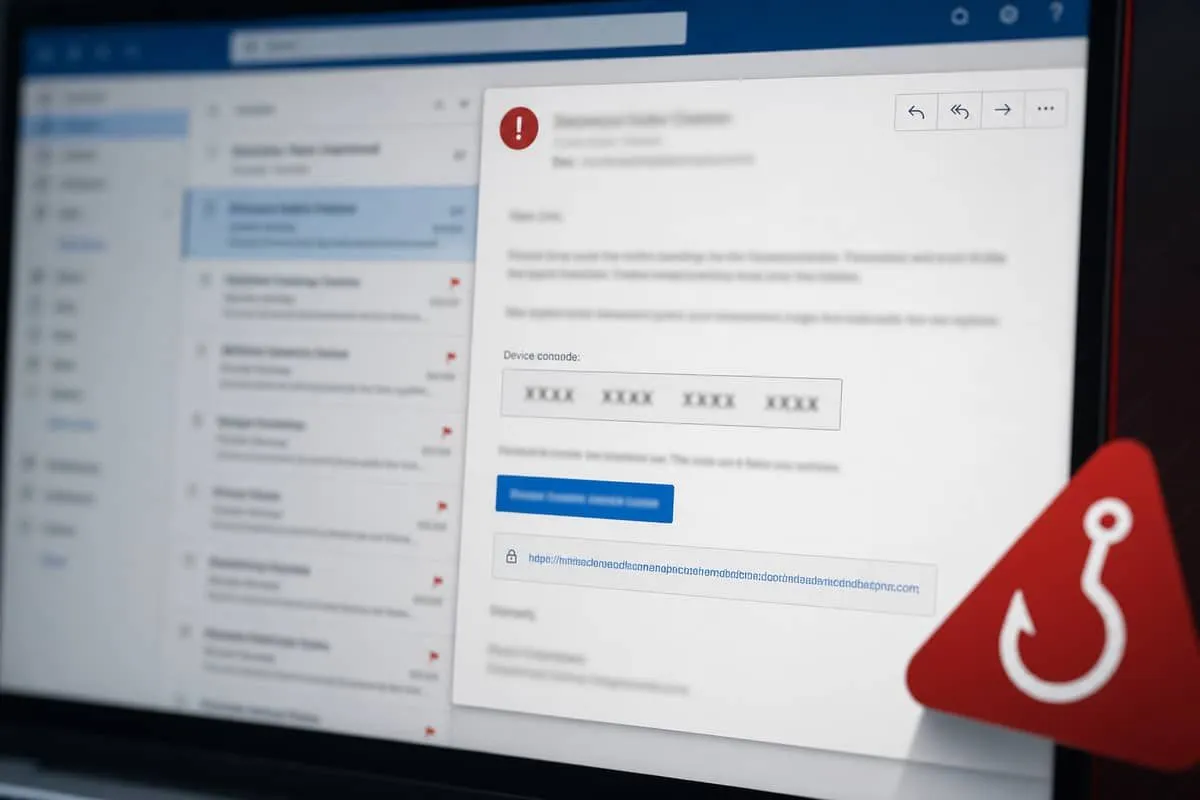
The victim receives email impersonating a trusted cloud or document service with a device code and instructions to visit Microsoft’s real verification page.
Step 2: Victim authorizes on the real Microsoft login page

The victim pastes the code on login.microsoftonline.com, unknowingly authorizing the attacker’s application — a legitimate Microsoft page, not a fake clone.
Step 3: Attacker captures OAuth tokens

The attacker captures OAuth access and refresh tokens and reuses them without re-entering MFA — persistent access to Outlook, Teams, OneDrive, and SSO-connected SaaS apps.
FBI and Defender Recommendations
- Create Conditional Access policies to block or restrict device code flow for all users except documented exceptions.
- Block authentication transfer policies that let sessions move between devices.
- Audit sign-in logs for device-code grants and unfamiliar application consents.
- Revoke sessions (
revokeSignInSessions) for compromised accounts immediately. - Watch for mailbox rules, new device registrations, and OAuth app consents after incidents.
- Report victims to IC3.gov.
Kali365 joins EvilTokens, Tycoon2FA, and other 2026 PhaaS platforms using the same technique.
Why Texas Law Firms and RIAs Are Targets
Legal and financial firms are heavy Microsoft 365 users with high-value mailboxes and wire-transfer workflows. A single compromised partner or paralegal account can expose client privilege, trust accounting, and SEC/FTC-regulated customer data.
This threat pairs with the April 2026 wave of vishing and SaaS attacks we summarized in our April cyber incidents roundup — identity-layer attacks that bypass traditional perimeter controls.
Independent Cybersecurity Audit
We audited Microsoft’s primary domains on June 22, 2026:
| Organization (Domain) | Overall | Risk Level |
|---|---|---|
| Microsoft (microsoft.com) | 73% | Good |
| Microsoft 365 / Office (office.com) | 59% | High Risk |
Strong microsoft.com scores do not stop Kali365 — victims authorize real Microsoft pages. The office.com gap in the High Risk band is a reminder that impersonation of Microsoft login flows remains effective when staff are not trained on device-code scams.
Audit links:
Harden Microsoft 365 before attackers do.
Run a free Instant Cybersecurity Audit at audit.emailmenow.com — and contact EmailMeNow IT Consulting for Entra Conditional Access review and BEC tabletop exercises.
Related trackers
- Texas OAG YTD dashboard
- Healthcare AG breach tracker
- Law firm breach tracker
- Financial services tracker
- Monitoring guide
- Washington healthcare breaches (2026)
- Washington law firm breaches (2026)
- CA September roundup
- TX September roundup
- WA September roundup
- TX Parks breach
- Have I Been Pwned
- HIBP September roundup
- Breach data week (September)
- HHS OCR September roundup
- SEC 8-K September roundup
- All trackers
Sources: FBI IC3 — Kali365 PSA · EmailMeNow audits — microsoft.com · office.com