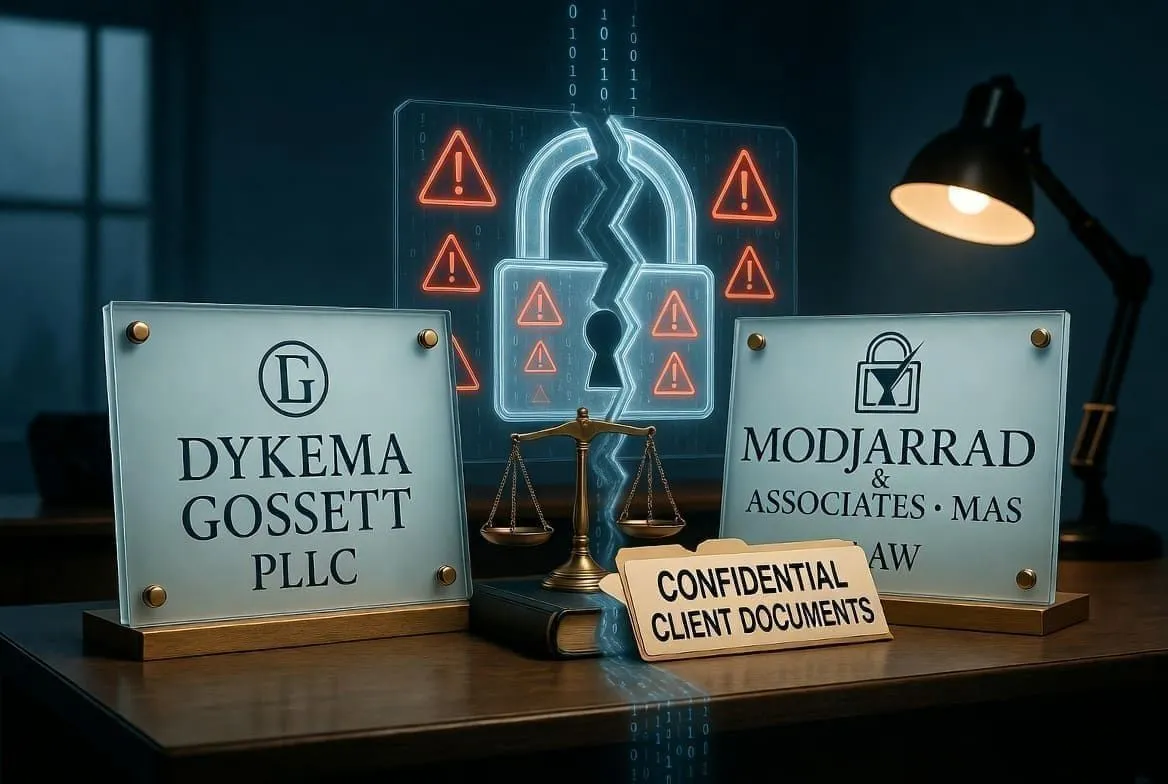
Two more law firms have appeared on the Texas Office of the Attorney General’s Data Security Breach Reports page, continuing a steady run of legal-sector incidents affecting Texas residents in 2026. Together, the two firms reported breaches affecting 12,352 Texans.
Dykema Gossett PLLC — 6,132 Texans
Dykema Gossett PLLC, a large full-service firm headquartered at 777 Woodward Avenue, Detroit, Michigan, reported a breach published May 28, 2026. The exposed data was extensive:
- Names
- Addresses
- Social Security numbers
- Driver’s license numbers
- Financial information
- Medical information
- Health insurance information
The firm reported providing notice to affected consumers via U.S. Mail.
Modjarrad & Associates, PC d/b/a MAS Law — 6,220 Texans
Modjarrad & Associates, PC, doing business as MAS Law, is a Richardson, Texas firm (212 West Spring Valley Rd). Its report, published May 22, 2026, covered 6,220 Texans and an equally sensitive data set:
- Names
- Addresses
- Social Security numbers
- Driver’s license numbers
- Government-issued ID numbers
- Medical information
- Health insurance information
- Dates of birth
Notably, the OAG listing indicates consumer notice was not recorded as provided at the time of publication. Under Texas law, entities are generally required to notify affected individuals when 250 or more Texans are involved; “No” entries may reflect timing, an ongoing investigation, or pending notification.
Post-Breach Security Posture Assessment
We ran an independent EmailMeNow Cybersecurity Audit against each firm’s public-facing domain on June 1, 2026. The results show that both firms have gaps that “may weaken documentation of reasonable cybersecurity safeguards” under Texas SB 2610 and TDRPC 1.05 — with Dykema Gossett scoring in the Critical range:
| Firm (Domain) | Overall | Risk Level |
|---|---|---|
| Dykema Gossett PLLC (dykema.com) | 36% | Critical Risk |
| Modjarrad & Associates / MAS Law (maslaw.com) | 64% | High Risk |
Key takeaways from the assessments:
- Dykema Gossett (36%, Critical Risk) lands in the lowest compliance band, indicating gaps that leave the domain highly exposed to email impersonation and phishing of clients.
- MAS Law (64%, High Risk) scores materially better overall, but still falls within the High Risk band.
- Neither firm reaches the 100% ideal, underscoring that even large, well-resourced practices frequently lack documented “reasonable safeguards.”
These public-facing weaknesses don’t prove how either breach occurred, but they illustrate exactly the kind of unhardened identity, transport, and web controls that make a law firm an easier target — and harder to defend as “reasonable safeguards” after the fact.
Website stack probe — maslaw.com
We rechecked what maslaw.com publicly reveals about its website software on July 17, 2026. Here is the plain-language result:
| What we checked | What we found |
|---|---|
| Website platform | WordPress (the core WordPress version is not shown publicly) |
| PHP (server language) | Outdated — running PHP 7.4.33, which stopped receiving security updates in November 2022 |
| Plugins in use | Contact Form 7, a cookie-consent plugin, and a Contact Form 7 file-upload add-on (versions visible in public page assets) |
| Theme in use | Attornix (plus a child theme) |
| Certificate (HTTPS) | Valid Let’s Encrypt certificate (about 45 days remaining at check time) |
| security.txt | Not published |
Bottom line: the clearest public red flag is outdated PHP. The site still advertises a PHP version that has been unsupported for years. This passive observation does not prove exploitability or show how the breach happened, but it identifies a concrete, fixable hygiene gap on a domain already listed in Texas OAG law-firm breach reporting.
An earlier parallel check of dykema.com showed Cloudflare in front and a server header that disclosed stack detail (RubyApps) — without the same EOL PHP signal.
A Pattern, Not a Coincidence
These two reports are not isolated. They join a growing 2026 list of law firm and legal-service breaches reported to the Texas OAG:
| Firm | Texans Affected | Date Published |
|---|---|---|
| Sprouse Shrader Smith PLLC | 17,666 | 05/05/2026 |
| Phillip Galyen P.C. dba Bailey & Galyen | 11,038 | 05/22/2026 |
| Modjarrad & Associates d/b/a MAS Law | 6,220 | 05/22/2026 |
| Dykema Gossett PLLC | 6,132 | 05/28/2026 |
| Gearhiser, Peters, Elliott & Cannon, PLLC | 3,717 | 03/17/2026 |
| Law Office of Michael R. De La Paz | 2,000 | 04/13/2026 |
| Rodenburg Law Firm | 606 | 04/24/2026 |
That is more than 47,000 Texans affected by law firm breaches reported in 2026 alone — and the list keeps growing. (See our earlier review of 21 law firm breaches and the Bailey & Galyen report.)
Why Law Firms Keep Getting Hit
Law firms concentrate exactly the data attackers want: Social Security numbers, driver’s licenses, financial records, medical information, and privileged client communications — often across many clients in a single matter. A breach can trigger:
- Texas breach-notification obligations (250+ Texans affected)
- Potential class-action exposure
- Professional-responsibility scrutiny under TDRPC 1.05 (confidentiality of client information)
- Questions about “reasonable safeguards” under Texas SB 2610
What Firms Should Do Now
The defenses are well established and defensible to document:
- Identity & spoofing protection — enforce strict SPF (
-all) and DMARC (p=reject) with a subdomain policy - Transport security — deploy MTA-STS in enforce mode, enable TLS-RPT and DNSSEC
- Website security — add HSTS, CSP, and X-Frame-Options headers
- Multi-factor authentication — on email, document management, and financial systems
- Vendor risk — review third-party access to client data
- Backups — protect from ransomware and test restoration
- Training & response — phishing awareness plus a documented, rehearsed incident-response plan
- Document everything for SB 2610 safe-harbor and TDRPC 1.05 compliance
Check your firm’s public-facing security posture with a free Instant Cybersecurity Audit:
For help responding to or preventing incidents like these, contact EmailMeNow IT Consulting for a full hardening package.
Related trackers
- Texas OAG YTD dashboard
- Healthcare AG breach tracker
- Law firm breach tracker
- Financial services tracker
- Monitoring guide
- CA June roundup
- TX June roundup
- WA May roundup
- TX Parks breach
- Have I Been Pwned
- All trackers
Source: Texas Office of the Attorney General – Data Security Breach Reports