Cyber insurance renewals are no longer a short questionnaire your IT manager can “just fill out.” In a July 14, 2026 Forbes Technology Council post, Keegan Crage describes mid-market applications jumping from roughly 40 questions to 73, with 14 MFA sub-questions — including whether MFA is enforced for admin logins to the backup repository. Those answers increasingly become the terms of the policy. Separately, Resiliently (April 2026) cites industry data that denial-or-partial-denial rates hit 21% in 2025 (up from 15% in 2023), with Fitch-linked reporting of roughly 1 in 4 denials in 2024.
For Texas law firms, dealers, healthcare, and other mid-market buyers: attesting to controls you cannot prove is now a claims risk — not just a premium risk.
Cost context (IBM / Ponemon Cost of a Data Breach Report 2026): global average breach cost hit a record USD 4.99M (+12%); the U.S. averaged USD 11.5M. Voice/SMS phishing and social engineering that includes MFA fatigue were among the costliest initial vectors (USD 5.29M / USD 5.23M). See IBM Cost of a Data Breach 2026. Beazley’s Q2 2026 lab report is the incident-side rhyme: 67% of ransomware still began with compromised VPN/RDP credentials.
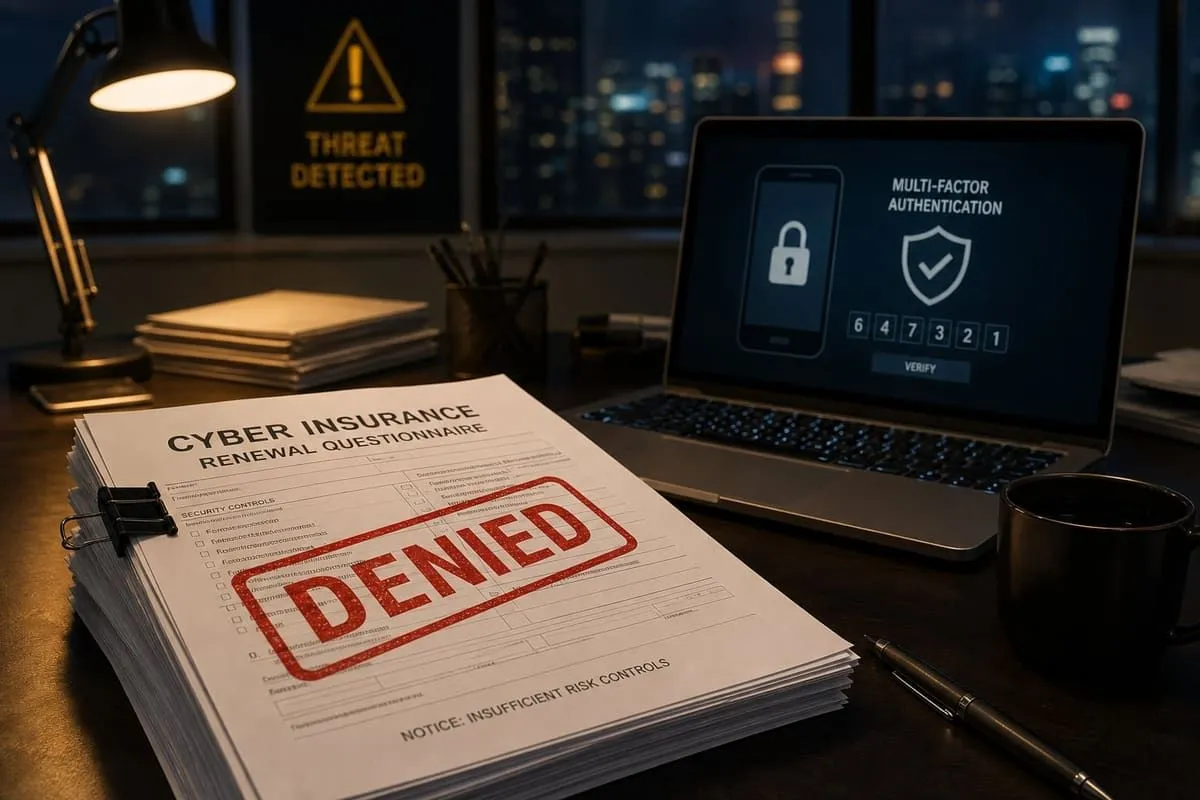
What Changed in Underwriting
| Shift | Detail (Forbes Tech Council, Jul 14, 2026) |
|---|---|
| From “do you have it?” to “where is it on?” | MFA expected across email, remote access, directory, network, servers, and backup admin |
| Application ≈ policy terms | Misstated controls can void or rescind coverage after a breach |
| Evidence over self-attestation | Underwriters want audit-grade proof of posture, not SharePoint PDFs |
| Outside-in scanning | External scans of internet-facing services sit beside the questionnaire (Fintech Global cited in the Council post) |
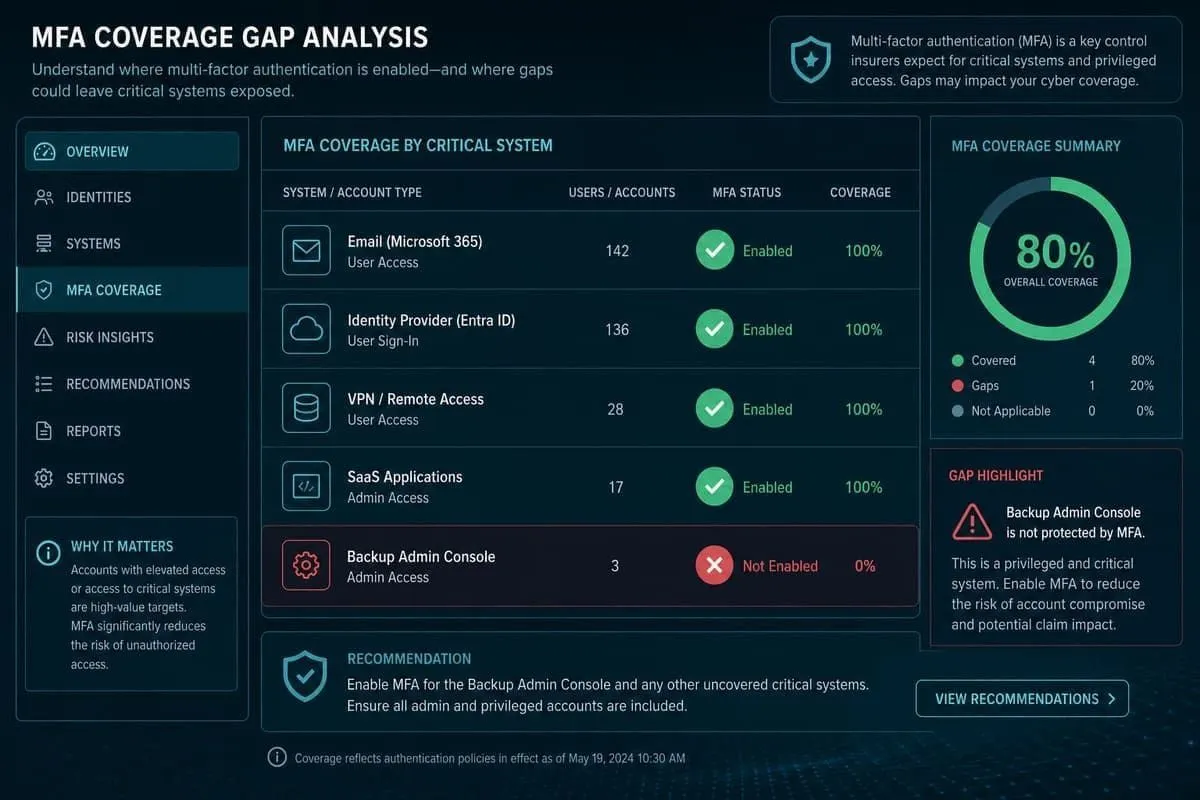
Crage notes that roughly one-third of claims denied in 2025 traced to controls marked present on the application but not actually operating. The landmark pattern he flags is Travelers v. ICS: MFA on the network but not on the server that was breached — the parties agreed the court could rescind the policy as null and void from inception.
Why Claims Still Get Rejected
Resiliently’s broker-facing breakdown (citing Fitch, ASi Networks, and claims analyses) maps the denial landscape like this:
| Denial reason | Share of denials | Trend |
|---|---|---|
| Failure to maintain stated controls (MFA, EDR) | 34–37% | Rising |
| Late notification (often >72 hours) | 17–22% | Stable |
| War / nation-state exclusion | 16% | Evolving |
| Pre-existing vulnerability not disclosed | 14% | Stable |
| Policy sublimit exhausted | 9% | Rising |
| Carrier expectation (Resiliently / Coalition figures cited) | Why it bites at claim time |
|---|---|
| 96% require MFA on all remote access | “MFA somewhere” ≠ MFA on every VPN / cloud admin path |
| 88% require EDR | Missing agents after a migration can breach a warranty |
| 73% run external vulnerability scans | Outside-in findings vs. application answers |
| 90+ days of security-tool logs | Having EDR without retained telemetry fails many warranties |
| Education sector denial rate ~27% | Complex IT + thin security budgets |
Resiliently also flags ransomware sublimits (many policies cap ransomware at 50–75% of the limit), thin social-engineering sublimits versus deepfake-scale losses, and war-exclusion wording that varies sharply by carrier after NotPetya-era disputes.
Evidence Underwriters Expect (Practical Checklist)
Crage’s “evidence-backed posture” list maps cleanly to what Texas mid-market firms should document before renewal — not after the ransomware call:
| Evidence package | What “good” looks like |
|---|---|
| MFA coverage report | Email, remote access, directory, network, servers, backup console — all enforced |
| EDR coverage report | Agents vs. actual endpoints; no silent gaps |
| Backup immutability | Domain admins cannot rewrite or delete protected backups |
| SIEM / log retention | Typically ≥90 days |
| Incident response | Tabletop exercised within 12 months |
| Honesty rule | Only attest what you can prove today |
Paper policies sitting unused in SharePoint are not enough: Crage cites a February 2026 Federal Court of Australia AUD 2.5 million penalty for a financial-services firm that failed to operationally deploy written cyber policies.
Independent Cybersecurity Audit
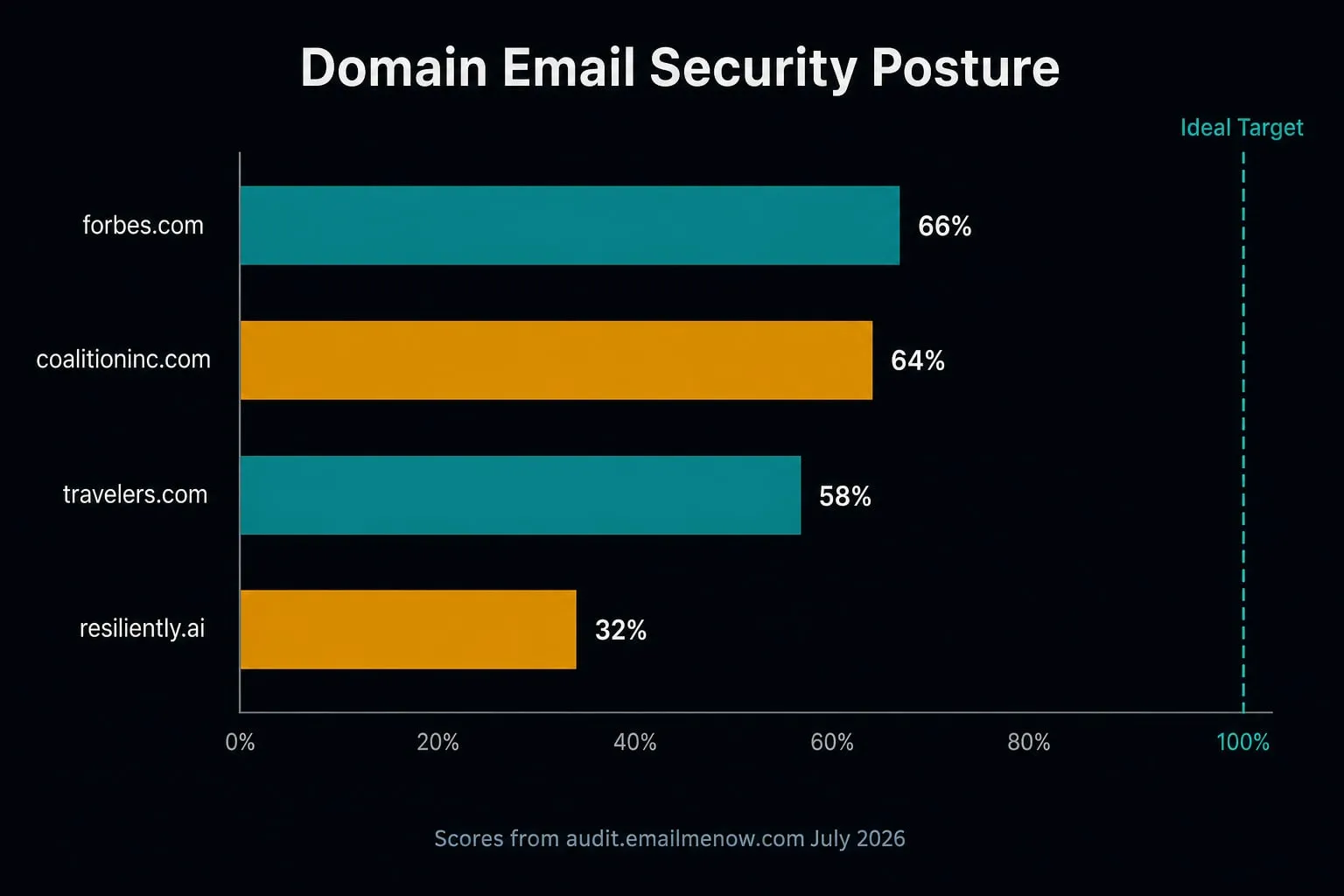
We scored publisher, insurer, and cyber-insurance vendor domains tied to this story on July 15, 2026. Authority: audit.emailmenow.com only. 100% is the ideal. Sorted highest → lowest.
| Domain | Overall | Identity | Transport | Website | Level |
|---|---|---|---|---|---|
| forbes.com | 66% | 40% | 15% | 97% | Above Average |
| coalitioninc.com | 64% | 40% | 15% | 92% | Above Average |
| travelers.com | 58% | 65% | 15% | 37% | Average |
| resiliently.ai | 32% | 0% | 15% | 37% | Weak |
| Finding | Detail |
|---|---|
| Ideal score | 0 of 4 at 100% overall |
| Soft transport | All four at 15% Transport in this pass |
| Soft identity | resiliently.ai Identity 0% / Forbes & Coalition 40% — spoofed “renewal / claims” mail remains a realistic risk |
| Strongest website | forbes.com Website 97% |
| Texas takeaway | Even coverage publishers and carriers show soft mail posture — treat unexpected insurance email as hostile; open the broker portal yourself |
Audit links: forbes.com · resiliently.ai · travelers.com · coalitioninc.com
Website stack note
Passive website-tech probes on July 15, 2026 covered all four domains (4 probed, 0 notable). No outdated CMS / PHP / short-horizon TLS alerts stood out. The operational story here is control warranties and claim evidence, not a public WordPress-core finding on these marketing domains.
What Texas Businesses Should Do Before Renewal
| Step | Action |
|---|---|
| 1 | Treat the questionnaire as a controls roadmap — map every MFA/EDR warranty to live systems |
| 2 | Prove MFA on backup admin, cloud consoles, VPN, and email — not just the primary IdP |
| 3 | Export EDR coverage + 90-day log retention evidence |
| 4 | Document an IR tabletop within the last year; rehearse the 72-hour notice call to the carrier |
| 5 | Read war exclusion and ransomware / social-engineering sublimits line by line with your broker |
| 6 | Harden brand email toward audit 100% (DMARC p=reject, MTA-STS) — spoofed “insurer” mail thrives after soft Identity scores |
| 7 | Only attest what you can evidence today (Forbes guidance) |
Related Coverage
- IBM Cost of a Data Breach Report 2026
- Beazley Q2 2026: AI CVE flood vs stolen credentials
- Seventh Circuit denies $4M cyber claim after CFO email hack
- Five Eyes AI cyberattacks warning
- Safe credit card processing: tokens & skimmers
- All cyber alerts
Sources: Forbes Technology Council — Keegan Crage (Jul 14, 2026); Resiliently — Denied: Why 1 in 4 Cyber Insurance Claims Gets Rejected in 2026 (Apr 19, 2026). Independent EmailMeNow domain audits and website-tech probes July 15, 2026. Domain scores: audit.emailmenow.com only. Not legal or insurance advice — confirm policy language with your broker and counsel.